
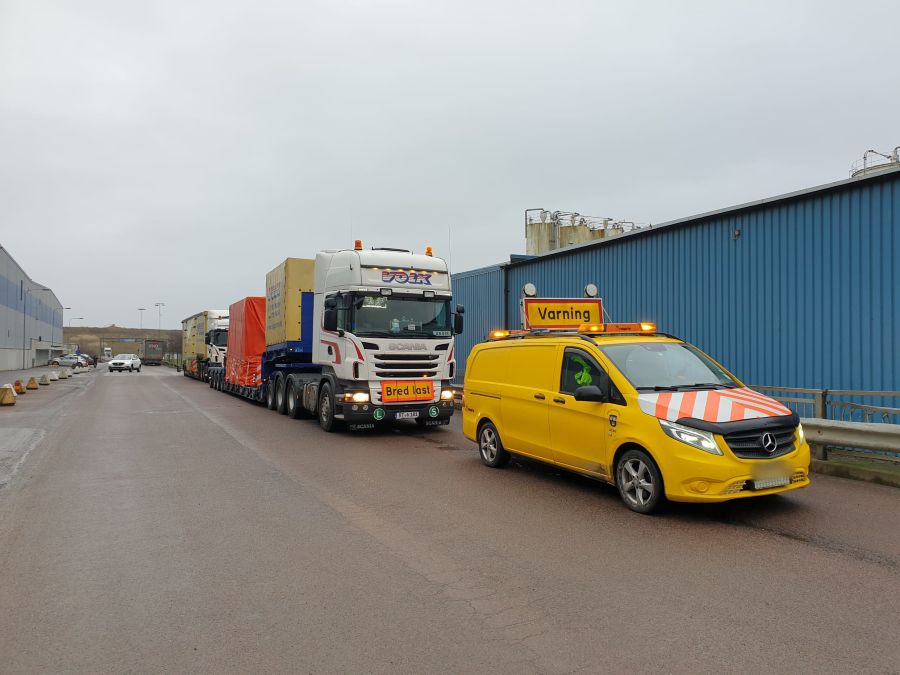
How to Plan a Special and Heavy Transport
Some transports require more planning than others. This is often the case when a load is particularly heavy, oversized or comes with specific transport requirements.
These transports require detailed preparation. The machinery itself is only one part of the planning. The route, permits and technical requirements also play a key role.
At VOLK, we distinguish between standard machinery transport and more complex special and heavy transports, which require significantly more extensive planning.
Machinery Transport vs. Special and Heavy Transport
A standard machinery transport generally involves machinery that can be loaded directly onto our specialised vehicles and transported without extensive additional planning. These projects can often be planned at short notice and require less coordination with the authorities.
More complex projects may fall into the category of special or heavy transport. This is typically the case when:
- Certain weight limits are exceeded
- The load has unusual dimensions
- Special requirements apply to the transport route or the transport itself
In these cases, standard transport planning is no longer sufficient. Additional permits may be required, and the route often needs to be assessed in detail.
1. Initial Project Assessment
As with every transport, the process begins with a detailed assessment of the project.
This includes:
- Weight and dimensions of the load
- Collection and delivery locations
- Site conditions at both locations
- Preferred transport period
Based on this information, we can already assess whether the project involves a standard machinery transport or a special and heavy transport.
2. Route and Feasibility Assessment
A key part of the planning process is assessing the transport route.
We analyse whether:
- Bridges have sufficient load-bearing capacity
- There are tight bends or restricted access routes
- Height restrictions apply
- Roadworks or road closures need to be taken into account
Particularly for special and heavy transports, it may be necessary to plan alternative routes or make adjustments to certain sections of the route.
3. Permits and Coordination with the Authorities
Once a transport qualifies as a special or heavy transport, specific permits may be required depending on the project.
We apply for the necessary permits with the relevant authorities. Depending on the route and country, additional requirements may also apply, such as:
- Escort vehicles
- Traffic management measures
- Police escorts
- Time restrictions, such as restrictions on night-time travel
Traffic management includes all measures required to safely guide the transport through public roads. This may include securing roads, temporarily closing sections of the route or setting up diversions.
Where required, we organise the necessary traffic management measures and coordinate them with the relevant authorities. This ensures that all requirements are met and the transport can be carried out safely and in compliance with the applicable regulations.
4. Technical Transport Planning
While the permits are being arranged, we are already planning the technical aspects of the transport.
This includes determining:
- Which specialised vehicles and transport equipment will be used
- Which lifting equipment is required for loading and unloading
- Whether additional technical equipment is needed
The aim is to carry out the transport as safely and efficiently as possible.
5. Preparing for the Transport
Once all permits have been obtained, the transport can be prepared in detail.
This includes:
- Scheduling vehicles and employees
- Coordinating the process with everyone involved
- Preparing the required transport and lifting equipment
This stage is particularly important for international special and heavy transports, as several countries and authorities may be involved.
Conclusion
Planning a special and heavy transport is a complex process that involves far more than simply arranging a vehicle. Technical feasibility, permits, route assessment and careful coordination all play an important role.
The more demanding the transport, the more important it is to plan early and thoroughly. This helps ensure that the transport can be carried out efficiently, smoothly and without unnecessary delays.
Comments are closed